Resource Center > Emerging Technologies
Background on the Federal System, Early Adopters, and Lessons Learned
In those states where cannabis generally remains unlawful, state law might correspond exactly with federal law, which (pursuant to the Controlled Substances Act), technically provides that the sale, possession, and use of the drug are serious crimes. Indeed, cannabis is a “Schedule I” drug under the CSA, which means it is considered to have no currently accepted medical use and a high potential for abuse. This classification means that cannabis use is virtually prohibited under federal law, even for research and medical purposes, which remain subject to draconian restrictions. Violators may face felony charges.
But in many states around the country, cannabis may only be forbidden as a matter of federal law. In fact, as of late 2018, 33 states and the District of Columbia have legalized at least medical uses of cannabis. Also as of late 2018, fifteen states have decriminalized use of the drug. Indeed, in some states, decriminalization has created a regime where the only penalty against personal use and possession of a small amount of the drug is a fine. This approach has proven an enticing alternative in those states where, for one reason or another, legalization has failed. For example, while legislators in New York recently failed to legalize cannabis, the state did enact legislation further decriminalizing the drug. Under the newly enacted decriminalization standards, the fine for possession of an ounce of marijuana is $50, while the fine for possession of two ounces is $200. The new law has eliminated an existing caveat for possession in public view, which long allowed for arrest and imprisonment.
Legalization: Lessons Learned
By 2016, Colorado, Washington State, Alaska, Oregon, and Washington, D.C. had legalized possession and recreational use of marijuana, and some such jurisdictions had legalized its sale, including, prominently, Colorado and Washington State. These early adopters reported a substantial reduction in arrests for unlawful use of the drug, resulting in significant savings on law-enforcement expenditures. Colorado and Washington State, which opened retail stores, did not report any obvious increase in traffic fatalities following legalization (while a slight increase in THC-related traffic fatalities was indicated in Washington, D.C.). As to revenue, for their second years of legal sales, the states of Colorado and Washington reported cannabis-related tax receipts of $129,000,000 and $220,000,000, respectively. The money was used for a variety of purposes, including school construction, drug enforcement, substance-abuse prevention and treatment programs, education, and community health services.
Colorado, the first state to legalize cannabis for recreational use, made its first sales on January 1, 2014. Looking back years later, state authorities, stakeholders, and commentators have offered many insights on legalization. In particular, one state official reported that the state had to change how it regulated dosing and serving sizes in response to the popularity of edibles. It eventually decided that ten milligrams of THC is an appropriate dose, and that edibles should be consumed in such units. Another consideration is how to effectively educate children about the drug, which is only intended for adult use but may wind up in minors’ hands. In a change in policy, Colorado has now shunned a “just say no” or “D.A.R.E.”-styled program in favor of educating children more holistically on drug use. Despite this, some stakeholders in Colorado have called into question the state’s efforts and ability to effectively regulate cannabis—especially cannabis-derived products that contain highly concentrated THC—to keep it out of the hands of minors. Indeed, while youth-usage trends were relatively unchanged after legalization, Colorado minors who do use cannabis apparently consume it in increasingly potent products, using technologies such as vaporizers.
Concentrated THC products have themselves raised concerns. Such products have reportedly caused an increase in emergency room visits for psychosis, attributable to the effects of an extremely intense high. And home use in “legal” states can at times turn dangerous, irritating, and unlawful, with bootleg efforts to extract pure THC leading to explosions in residential neighborhoods, odor and nuisance complaints, and criminal conspiracies between private citizens and dispensaries to make black-market sales. Despite these concerns, however, legalization has only expanded. As of mid-2019, ten states (along with Washington, D.C.) have legalized cannabis. One caveat, though, is that D.C. and Vermont do not allow sales of the drug, so while it is legal for adults to possess and use it, it cannot be lawfully purchased in those jurisdictions.
In short, the legalization situation as of mid-2019 can be summarized as follows:
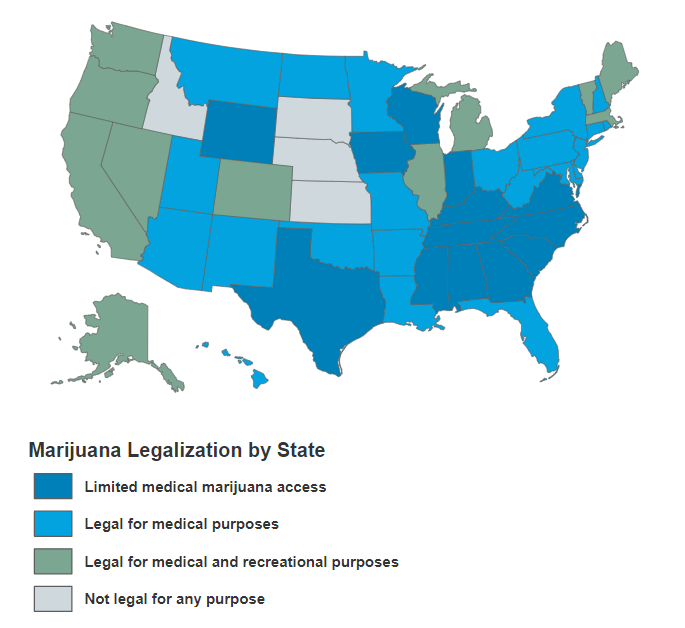
Credit: Mitchell, https://www.mpower.mitchell.com/us-marijuana-laws/.
One additional point bears mentioning in connection with legalization: the scale of the U.S. market for cannabis. Based on recreational demand alone, the U.S. market for the drug has been estimated to be worth around $55 billion in annual sales. Today, existing cannabis enterprises are investing in states where the drug has recently been legalized. Recently, for example, a top-selling brand in California invested $25.8 million in operations in Nevada, Michigan, and Massachusetts. Additionally, investment in the general industry is on the rise. In recent years, for example, venture-capital funds have reportedly invested five-hundred-million dollars in ancillary businesses which support the cannabis industry, such as vendors supplying goods and accessories to cannabis businesses. Now, cannabis investment is underway in a more immediate fashion, particularly in those states which have recently legalized the drug. For example, Ascend Wellness Holdings, a distributor and investment firm based in Boston, raised $55 million for further investment into private rounds of other cannabis companies. It closed a $30 million round in or about summer 2019.